Jun 8, 2026
OPERAT and the Green Fund: how to finance the energy renovation of public buildings?

Energy renovation of public buildings represents a major challenge for local authorities. Faced with rising energy costs, an aging real estate heritage, and the targets set by the Tertiary Decree, it is becoming essential to better understand building consumption and to plan the most effective works.
In this approach, the OPERAT platform makes it possible to measure and monitor the energy performance of tertiary buildings. Meanwhile, the Green Fund can financially support local authorities undertaking energy renovation works.
These two initiatives therefore meet different, yet complementary, objectives. OPERAT helps to understand, monitor, and manage consumption, while the Green Fund facilitates taking action.
OPERAT, the monitoring platform for the Tertiary Decree
OPERAT, which stands for Observatory of Energy Performance, Renovation, and Tertiary Actions, is the national platform developed and managed by ADEME to monitor the Éco Énergie Tertiaire scheme.
Also known as the Tertiary Decree, this scheme imposes a gradual reduction in final energy consumption for buildings, parts of buildings, or building complexes hosting tertiary activities on a cumulative surface area of at least 1,000 m².
The reduction targets are set at least 40% in 2030, 50% in 2040, and 60% in 2050, compared to a baseline energy consumption. The obligation can also be met by achieving an absolute consumption value, defined according to the category of activity carried out in the building.
Each year, the owners and occupants concerned must enter their energy consumption in OPERAT. The platform notably takes into account electricity, gas, heat, and cold, as well as the characteristics and uses of the buildings.
OPERAT thus makes it possible to locate each building in relation to its regulatory trajectory and generates an annual energy performance certificate.

Useful data to identify buildings to renovate
Beyond the regulatory declaration, the data centralized in OPERAT can help local authorities to better understand their real estate heritage.
The analysis of consumption makes it possible to identify the most energy-intensive buildings, spot deviations, and compare the performance of several facilities. A local authority can thus distinguish buildings requiring major works from those for which improved management or usage could already generate savings.
This knowledge is particularly useful when a municipality or a group of local authorities must decide between the renovation of a school, a town hall, a gymnasium, a cultural center, or any other public facility.
Data from OPERAT can therefore contribute to establishing an initial hierarchy of buildings to address. However, they must be supplemented by technical studies to accurately determine the necessary works, their cost, and the expected savings.
The Green Fund supports the renovation of public buildings
Renewed for 2026, the Green Fund supports local authorities in financing their ecological transition projects. The energy renovation of local public buildings is one of the priorities of the scheme.
This aid is aimed at local authorities and their groupings for work carried out on existing buildings that they own. It can notably concern town halls, schools, sports facilities, administrative buildings, and cultural facilities.
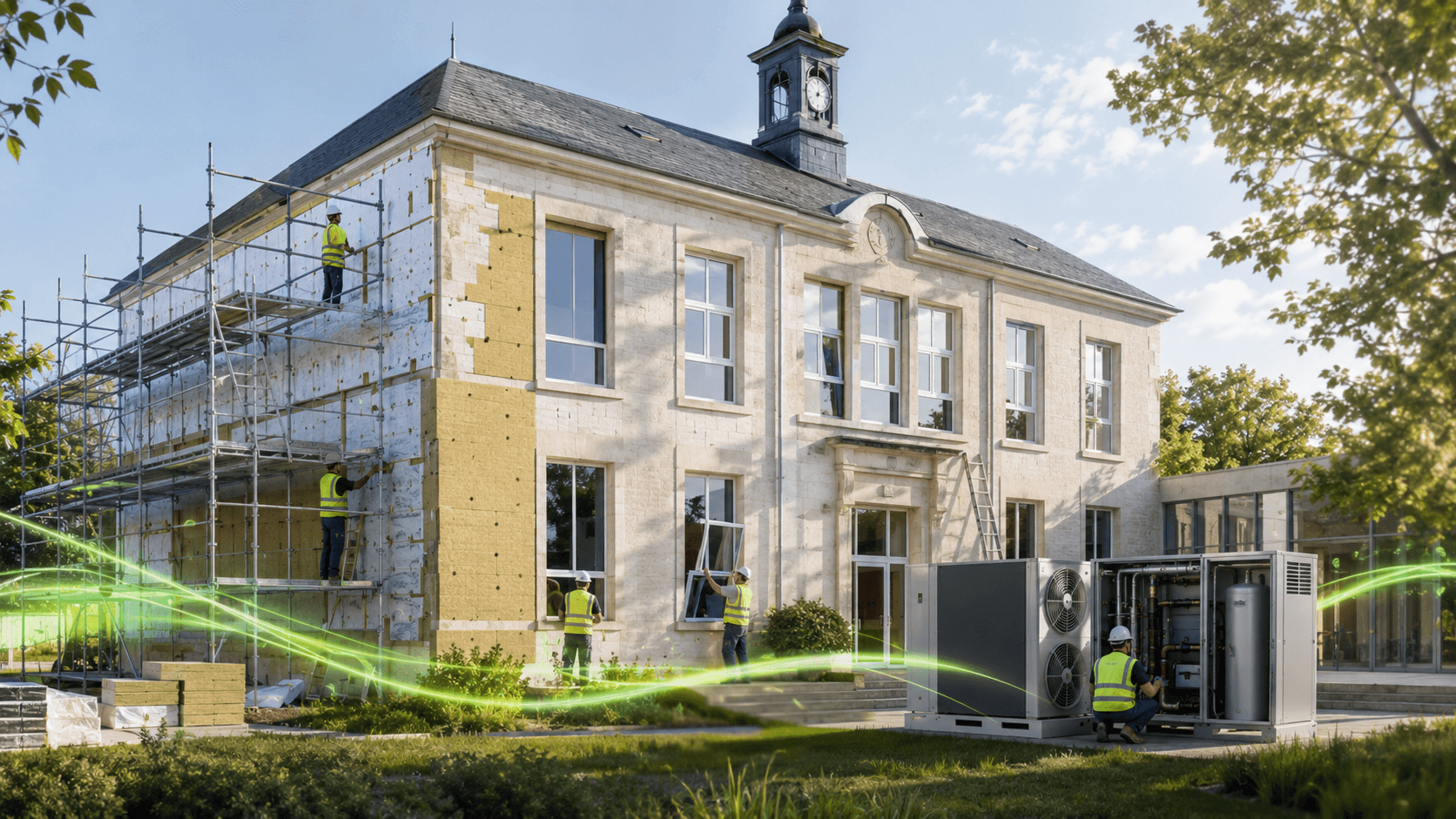
The supported operations can cover the insulation of walls, floors, or roofs, the replacement of joinery, the improvement of heating and hot water production systems, ventilation, lighting, or the installation of control and active management systems for equipment.
The Green Fund can also support actions that improve summer comfort, such as the installation of external solar protection or passive solutions to limit building overheating.
The objective is to finance renovations capable of sustainably reducing the consumption, greenhouse gas emissions, and energy expenses of local authorities.

A minimum reduction of 40% expected
In metropolitan France, energy renovation projects for tertiary buildings must achieve a reduction of at least 40% in final energy consumption across the five regulated uses.
These uses correspond to heating, cooling, domestic hot water production, lighting, and auxiliaries, such as pumps and fans.
The project must also lead to a significant reduction in greenhouse gas emissions. New installations operating on fuel oil or coal are not eligible. Projects planning a new gas installation are highly regulated, with the Green Fund giving priority to the electrification of uses as well as renewable and recovery energy sources.
The announced energy savings must be justified by a thermal study comparing the building's situation before and after the works. This study therefore constitutes an essential document to demonstrate the project's eligibility.
Is OPERAT enough to submit a Green Fund application?
The data declared in OPERAT provides useful information on historic consumption and the building's energy trajectory. It helps document the existing situation and demonstrate the benefit of undertaking a renovation.
However, an OPERAT certificate does not replace the thermal study required under the Green Fund.
OPERAT evaluates the overall performance of the building in light of the Tertiary Decree. The thermal study, on its part, must demonstrate the precise impact of the work program on the building's energy consumption.
The two procedures can nevertheless be articulated. The consumption monitored in OPERAT contributes to establishing the initial assessment. The thermal study then allows for building and justifying the renovation program. After the works, the new consumption can be compared to historical data to measure the savings actually achieved.
OPERAT is therefore a tool for knowledge and monitoring, but not a sufficient condition for obtaining Green Fund financing.
The Green Fund can also cover certain engineering services directly necessary for the preparation and implementation of the project. This can notably include preliminary diagnostics, the definition of the work program, the evaluation of its impacts, and the thermal study necessary to justify the eligibility of the operation.

Moving from declaration to energy management
For a local authority managing multiple buildings, the challenge lies not only in the annual declaration of energy consumption. It primarily consists of consolidating data from different sources, ensuring its reliability, and transforming it into operational decisions.
A global view of the property portfolio makes it possible to track consumption over time, compare buildings, detect anomalies, and measure the gap between the current situation and regulatory targets.
It also facilitates the development of a multi-year investment program. Buildings with the highest energy consumption, the largest gaps relative to targets, or the best prospects for savings can thus be prioritized.
Energy monitoring must continue after works are completed. The comparison between theoretical savings and actually observed consumption makes it possible to verify the effectiveness of the interventions and to adjust the operation of the equipment.

How UrbanThink supports local authorities
UrbanThink Platform supports local authorities in collecting, centralizing, and analyzing their energy data.
Thanks to ThinkCities®, consumption from different buildings can be consolidated into a single dashboard. The platform makes it possible to visualize trends, compare equipment, identify priority buildings, and track their reduction trajectory.
Data from meters, utility bills, business tools, and OPERAT can be cross-referenced with building characteristics to obtain a consolidated and directly actionable view of the real estate portfolio.
This approach facilitates the preparation of renovation strategies and the production of indicators required for project monitoring. Following the works, the dashboards allow measuring the savings achieved and verifying that the buildings are progressively moving closer to the Tertiary Decree targets.
OPERAT helps monitor regulatory obligations, while the Green Fund can contribute to financing the works. By linking energy data, investment planning, and performance tracking, local authorities have a comprehensive approach to accelerate the renovation of their public buildings.
Do you want to identify the priority buildings in your portfolio and structure your energy renovation strategy? Contact UrbanThink to discover how ThinkCities® can support you.