Apr 14, 2026
Tourism and outdoor hospitality in 2026: climate adaptation becomes an operational challenge
A dynamic tourism sector, but increasingly exposed
French tourism remains very strong. In 2025, France welcomed 102 million international visitors and generated €77.5 billion in international revenue. At the same time, campsite attendance continued to grow, with an increase of 2.2% in the third quarter of 2025 compared with the previous year according to Atout France.
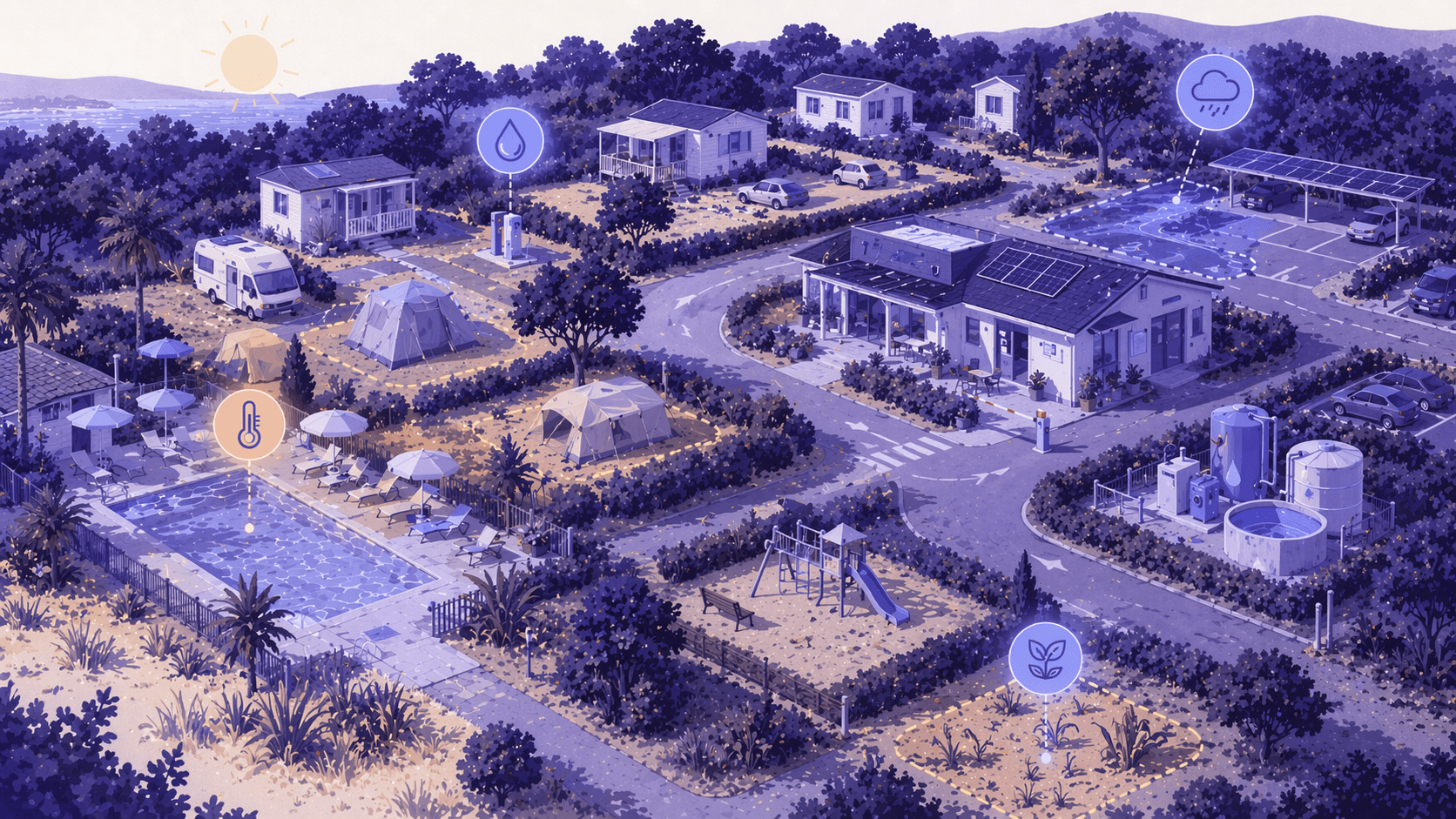
However, this momentum masks a more demanding reality for operators. In tourism and open-air hospitality, the performance of a site no longer depends solely on its attractiveness, facilities, or occupancy rate. It also depends on its ability to cope with more frequent heat waves, water stress, heavy rainfall, localized runoff, or the weakening of certain areas and facilities. The third National Climate Change Adaptation Plan also confirms that France must incorporate risks such as heat waves, floods, droughts, and coastal erosion into its planning.
In other words, climate is no longer just a long-term forecasting issue. It is becoming a concrete operating parameter. For a campsite, a holiday residence park, a marina, or a large outdoor tourist site, this changes the way operations, maintenance, guest services, and investment priorities are approached.
Adaptation becomes operational
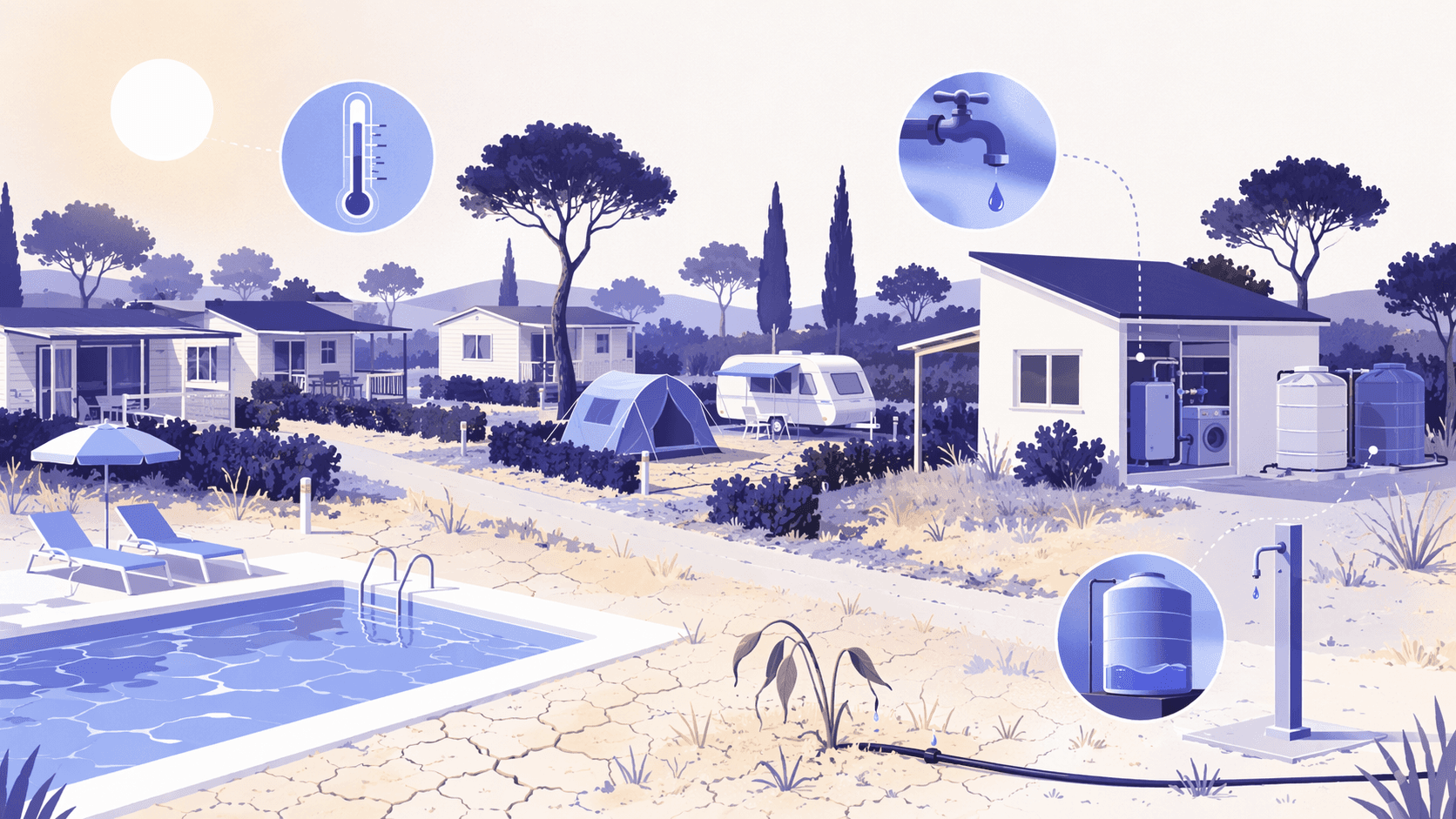
The first signal of this change concerns water resources. Atout France reminds us that tourism activity depends heavily on water for hygiene, catering, watering, and leisure facilities. This pressure is now reflected in public support schemes. In 2025, the call for expressions of interest dedicated to water resource management selected 25 projects, several of them directly linked to open-air hospitality. Among them, Homair Vacances is, for example, aiming for a 15% reduction in water consumption in the campsites it supports.
This development reveals a change in logic. A heatwave is no longer just a matter of comfort; it can increase consumption, change how a site is used, weaken certain areas, and add pressure on equipment. Similarly, a runoff or local flooding event is not only about risk prevention: it can disrupt traffic flow, affect networks, temporarily render certain areas unavailable, or lead to unexpected intervention costs. For operators, climate is therefore becoming a business continuity issue.
The overall economic cost of these hazards also reinforces this interpretation. France Assureurs indicates that the cost of natural events in France reached €5.2 billion in 2025. This figure goes beyond the insurance framework alone: it reflects growing pressure on assets, prevention, insurability, and, more broadly, on investment decisions. For a tourism player, this means that a resilient site must now be able to anticipate its vulnerabilities as much as manage its visitor numbers.
The public framework is pushing players to anticipate more
The institutional context is moving in the same direction. The Ministry for Ecological Transition indicates that as of 19 February 2026, 80% of the actions planned under the third National Climate Change Adaptation Plan had already been launched. The PNACC also relies on a Reference Warming Trajectory for Adaptation to Climate Change, with targets set at +2°C in 2030, +2.7°C in 2050, and +4°C in 2100 for mainland France and Corsica. The challenge is therefore no longer whether adaptation should be undertaken, but how to integrate it into organizations' concrete decisions.
Companies are also explicitly encouraged to carry out a vulnerability assessment. The Directorate General for Enterprises points out that adapting first means identifying the physical climate risks weighing on the business. For tourism and open-air hospitality players, this approach is particularly relevant: it makes it possible to move beyond a too-general view of climate change and return to very concrete site, equipment, usage, and operational issues.
The sector's regulatory framework is also evolving. Decree No. 2026-14 of 14 January 2026 has made several provisions relating to the definition and classification of commercial tourist accommodation more secure and simpler, including campsites, other developed sites, and holiday residential parks. Some provisions will come into force on 1 September 2026 for classification decisions expiring from that date onward. Even if the text does not directly concern climate, it confirms a broader trend: operational quality, site control, and clarity in how a site functions are becoming increasingly structural dimensions.
For operators, the challenge is now to manage rather than endure
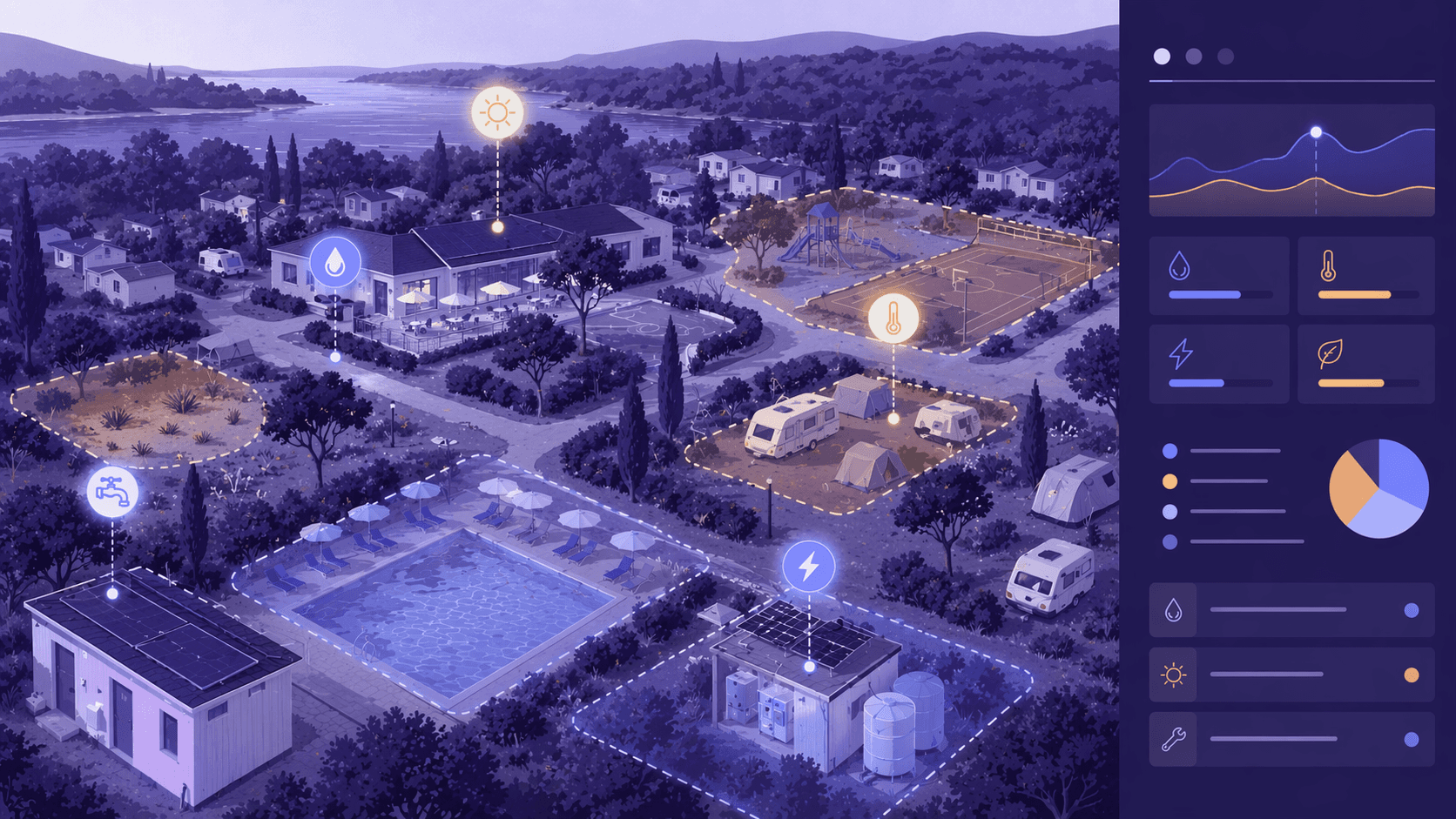
In this context, the real issue is not only having data, but being able to cross-reference it intelligently. Many tourism businesses already have useful information: consumption readings, incident histories, technical documents, network plans, weather data, field observations, or regulatory constraints. The problem is that this information often remains scattered, siloed, or difficult to turn into operational decisions. Yet in times of strain, isolated data helps little; what matters is the ability to connect information with one another to understand where the priorities lie.
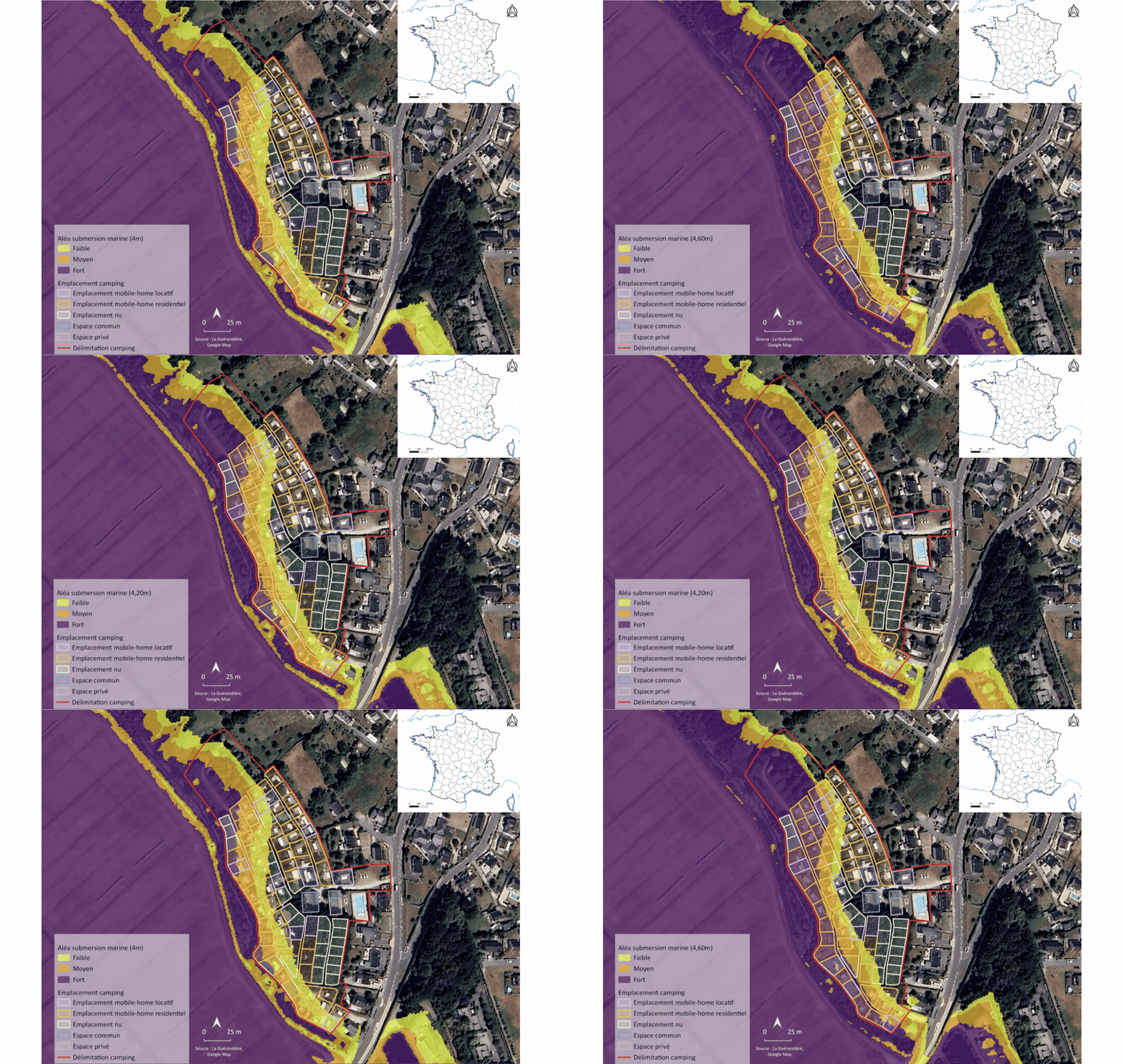
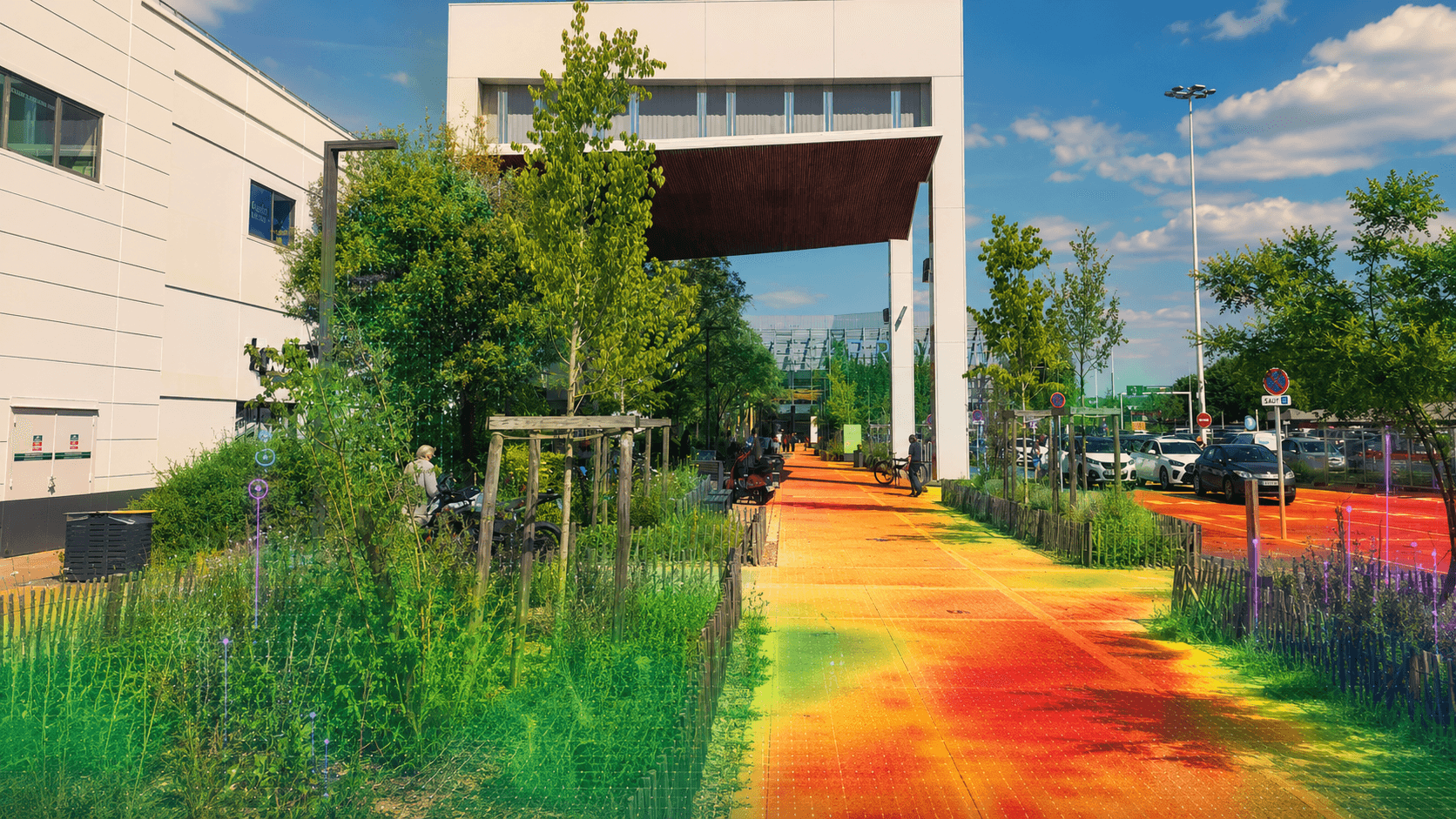
For campsites and major tourist sites, this changes the way performance is approached. It is no longer just about optimizing reception or services, but also about identifying the areas most exposed to heat, the sectors sensitive to runoff, critical equipment, possible water stress, or spaces whose use becomes more fragile in high season. This combined reading makes it possible to better prioritize actions, better direct investments, and strengthen operational continuity.
The role of UrbanThinkPlatform
In 2026, climate adaptation therefore becomes an operational issue on the same level as maintenance, attendance, or service quality. For tourism and outdoor hospitality players, the ability to turn scattered data into operational decisions becomes a very concrete advantage.
ThinkCities helps precisely to centralize key indicators, map vulnerabilities, and track consumption to facilitate decision-making. The platform is designed for tourist sites and multi-site management approaches, with a risk-management and action-prioritization framework.
Better reading a site means better protecting its activity, better directing its investments, and better preserving its attractiveness in a more unstable context. This is exactly what operators are looking for today when they want to move from reactive management to a resilience strategy. To go further, discover our approach dedicated to the sector on the page ThinkCities for tourism and outdoor hospitality, or also consult our mapping and environmental management projects.