Jan 3, 2026
European Climate Objective 2040: what impacts for businesses?
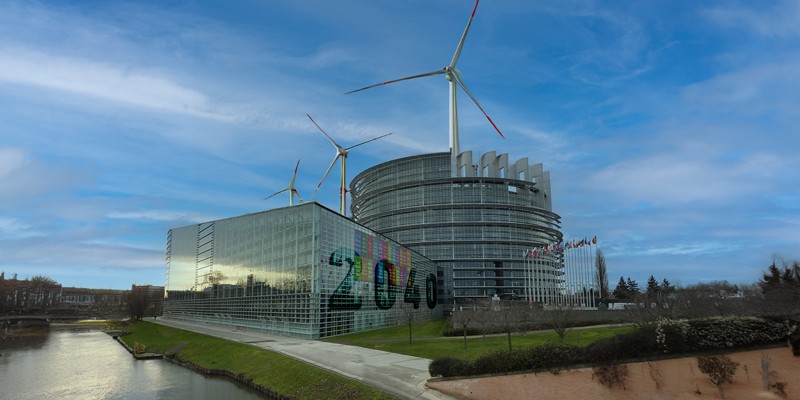
A major climate turning point for the European economy
In November 2025, the European Union enacted a profound change in its climate policy. The Council of the European Union and the European Parliament adopted their positions on the revision of the European Climate Law, setting a legally binding target to reduce 90% of net greenhouse gas emissions by 2040 compared to 1990.
This target is not just an intermediate milestone towards carbon neutrality by 2050. It marks a break in the way European climate policies now apply to economic actors. For businesses as for public organizations, 2040 becomes a structuring strategic horizon.
What does the European climate objective 2040 actually entail?
The European climate objective 2040 is based on a central requirement: the effective and measurable reduction of emissions across all economic systems. It is no longer just about improving energy efficiency or resorting to carbon offsetting mechanisms, but rather about engaging in a structural transformation of existing models.
Specifically, this framework implies in particular:
an absolute reduction in emissions, and not just relative
a strengthened credibility of reduction trajectories over time
a strict regulation of offsetting mechanisms
a clear articulation with the 2030, 2040, and 2050 targets
These principles reflect a change in logic: climate performance becomes a subject of strategic management, on par with economic performance.

Why this goal directly concerns businesses and organizations
Contrary to a still widespread idea, the European climate goal 2040 is not only aimed at the Member States. It is already spreading in many regulatory, financial and economic frameworks that directly concern public and private organizations.
It can notably be found in:
the requirements for non-financial reporting and ESG
the conditions for accessing public and European funding
the growing expectations of investors and insurers
the selection criteria in tenders and partnerships
For companies, developers, asset managers, infrastructure operators, and actors in tourism and real estate, the 2040 objective becomes a structuring parameter for strategic decisions.
From a compliance logic to a low-carbon management logic
For a long time, the response to the climate challenge was translated into regulatory compliance approaches. Conducting a carbon assessment, defining an action plan, and publishing an annual report were sufficient to meet institutional expectations.
This model has now reached its limits. The new European framework imposes a deep evolution of posture. Organizations must now be able to answer operational and measurable questions, such as:
what are the main sources of emissions today?
which levers provide the best carbon impact per euro invested?
which scenarios are compatible with the 2030 and 2040 objectives?
how to measure the real impact of decisions over time?
Without appropriate management tools, low-carbon pathways remain theoretical and difficult to defend with stakeholders.
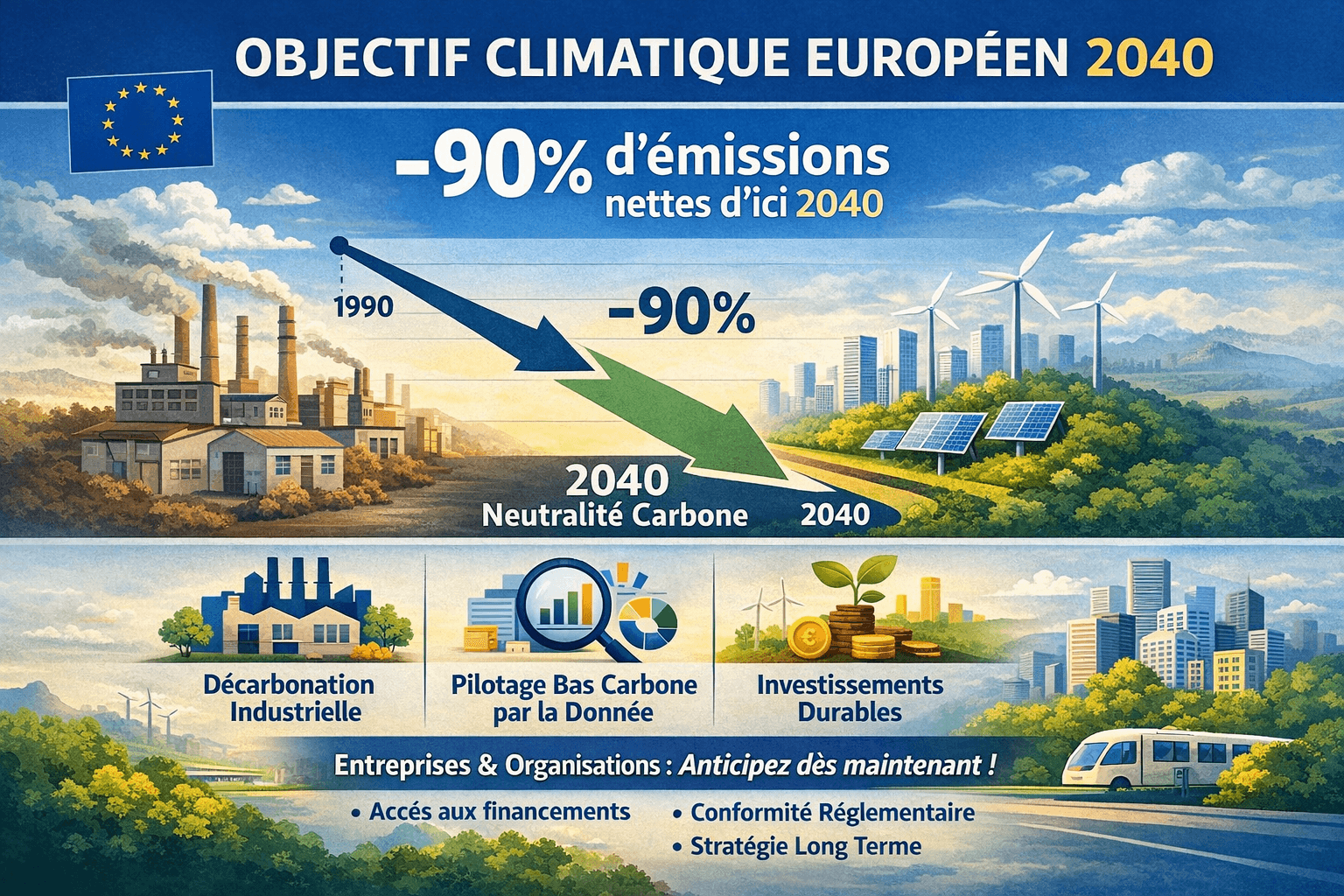
Environmental data as the foundation for decarbonization paths
Achieving a 90% reduction in emissions by 2040 requires an approach based on environmental data. The most robust strategies rely on utilizing data from multiple sources, covering energy, uses, heritage, mobility, climate, and land.
Spatializing data allows for a better understanding of impacts, identifying vulnerabilities, and prioritizing actions. Comparable scenarios over time are essential to measure the real effectiveness of decisions and adjust paths if necessary.
In this context, the ability to transform complex data into readable and actionable decisions becomes a major strategic lever.
Anticipating the 2040 climate objective to enhance overall performance
Organizations that anticipate today the European climate objective for 2040 gain a sustainable advantage. This anticipation helps secure funding, better prioritize investments, and strengthen resilience against climate, energy, and regulatory risks.
In contrast, a late approach exposes to constrained trade-offs, often costly, made in urgency. The lower the anticipation, the more strategic maneuvering margins shrink.
2040: An operational horizon to integrate now
2040 may seem distant, but on the scale of investment cycles, infrastructures, buildings, or energy systems, it is a very near horizon. For many organizations, this corresponds to a single major strategic cycle.
The question is no longer whether to act, but how to structure today a manageable, measurable, and realistic low-carbon trajectory, capable of sustainably fitting within the European climate framework.